
Chapter 1: What the Forest Kept
The Heartbeat in the Stone

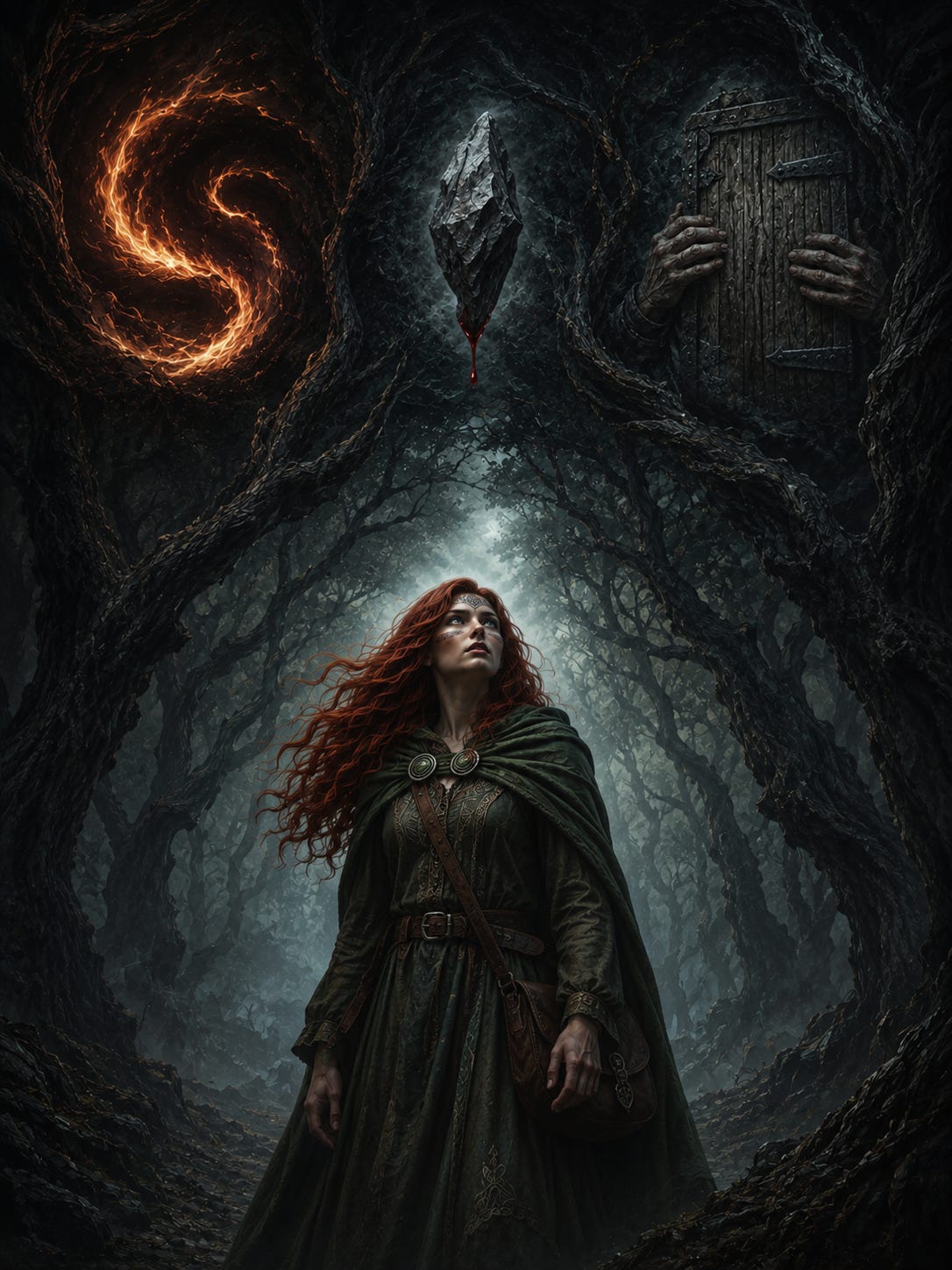
The path was wrong. Aisling knew it bone deep.
She had walked this trail through Elderglen for as long as she could remember, her small feet once chasing the hem of Maeve’s cloak as she learned every moss-slicked stone, every root that crossed the earth.
She knew this path the way she knew her own breathing. Now, it coiled back on itself, ending at a wall of brambles that had not stood there at midday. The briars twisted over one another like something trying to close around a hidden cut in the land. The forest no longer felt like Elderglen.
She left the path and pushed into the undergrowth, branches dragging against her cloak. Briars scraped softly against leather; wet leaves folded beneath her boots. The silence had changed. Something moved within it now.
Then, beneath her own breathing, she heard it—a whisper like dry leaves crossing stone where no wind reached.
“Sable.”
Her fingers closed around the medallion beneath her tunic. It flared against her palm, sudden, searing, and the whisper ceased. The forest drew a breath and held it.
Ahead, through the branches, a torch flickered. Aisling moved toward it before she realized her feet had chosen a direction.
Moments later, she broke through the trees into the clearing outside Branwyll. She bent forward, catching her breath, one hand still pressed against the medallion beneath her tunic. The heat had faded, but her palm still stung.
Then she saw the crowd gathering in the square.
The unease from the forest had already bled into the village.
Branwyll’s square was full, which meant something was wrong: her neighbors didn’t gather after dark without reason. Aisling moved to the edge of the crowd and listened. The voices were low—the way voices go when fear has been sitting with people long enough to become familiar. She caught fragments, vanished overnight… the king’s guard sent and not returned, paths that twisted back on themselves in the eastern glens. Someone near her said the trees had known his name. No one laughed.
At the center of the square stood Eryndor. He was not reading the parchment; he held it the way a man holds something he has been dreading for thirty years—carefully, as though the weight of it might finally be real. His storm-grey eyes moved across the gathered faces with an expression Aisling had never seen on him before. Not fear. Something older than fear; the look of a man whose warnings had finally come true and who took no satisfaction in it.
She had heard his stories all her life: the Fianna, the old oaths. The things that slept beneath Mórradún’s hills and would wake when the land called them. Most of Branwyll had listened the way people listen to rain, present, then forgotten. Eryndor had never stopped telling them.
He unrolled the parchment slowly, as though giving them a moment of safety before the world changed.
Beneath the royal seal, a single line:
“Hold fast. Help will not come.”
The crowd did not speak. They looked at Eryndor the way the village had always looked at him when the world felt wrong, waiting for him to say it wasn’t. He did not say it.
“I have kept these stories for thirty years,” he said quietly, “because I believed the day would come when they were needed.” He looked toward the darkened wood at the edge of the square, and something in his face settled into grief. “I did not want to be right.”
He let the silence hold for a moment.
“Something ancient has awoken. We must prepare.”
His words settled over them like ash.
From somewhere near the well, a young woman’s voice broke the stillness.
“Will the Fianna return? The songs say they came before, when we needed them most.”
Eryndor turned toward the darkened wood. For a long moment, he said nothing. When he spoke, his voice was barely above a whisper.
“I have to believe they will.”
The crowd held its breath. A cold wind moved through the square, stirring the lantern smoke toward the trees. Somewhere in the forest, a branch cracked.
Aisling’s breath caught. She had not spoken, but the question clung to her ribs as if it were her own.
The old stories rose unbidden heroes: bound by oath, firelit blades, voices that had once defied the dark. Aisling didn’t know when she had stopped believing them. Somewhere between childhood and now they had become the kind of thing you carried quietly, like a stone in a pocket whose weight you no longer noticed.
Then Daith the bard stepped forward.
The crowd stilled. He was not a large man, but the silence he drew around himself was.
He began softly, as though afraid the forest might hear him.
Rise, O Fianna, fierce and true —
Near the front, an old woman closed her eyes. Beside her, a man Aisling recognized from the mill lifted his chin as though answering something. Around her, the older faces changed, not calmed, not hopeful, but present in a way they hadn’t been a moment before. The song lived in them somewhere. She could see it finding the place where it had always been kept.
From forest deep and river’s blue. Awaken now, our ancient kin—for Mórradún calls from deep within.
Where shadows stretch, and whispers grow, and stars keep watch o’er fields below the Fianna stand, both flame and stone, guardians sworn to shield their own.
The lantern smoke had stopped drifting. Aisling noticed without understanding why.
But darkness stirs, the spirits fade the oath once sworn must be obeyed. From mountain’s peak to ocean’s roar the Fianna’s strength shall rise once more.
The final note dissolved into the dark.
Then, from the edge of the crowd, came Ailill’s voice, flat, tired, almost gentle in its certainty. “Old songs won’t save us.”
No one answered him. But no one argued either. The silence that followed wasn’t agreement. It was the silence of people who had felt something move through them and weren’t ready to name it yet.
Aisling’s fingers had found the medallion beneath her cloak without her choosing to.
It was warm. Not the searing heat of the forest. Something quieter as though it recognized the words and had been waiting for them.
Maeve’s voice was in her memory before she realized she was hearing it. The Fianna will always be there, child. When the land calls, they answer. She had grown up believing that the way she believed in the hearth’s warmth, not because she had tested it, but because Maeve had never been wrong about the things that mattered.
She had not spoken the young woman’s question. But it had already found her.
The crowd was dispersing when Maeve appeared at Aisling’s side.
She said nothing at first. She looked at the place beneath Aisling’s tunic where the medallion lay hidden, the way you look at something you have been watching for a long time and have finally seen move.
She touched Aisling’s arm once, light and brief, and gestured toward the embers at the heart of the square.
When they were apart from the others, Maeve stopped walking. Her grey eyes, sharp as they had always been, held something Aisling couldn’t name. Not fear. Not quite grief. The expression of a woman setting down something she had carried alone for a very long time.
“Let me see it,” she said.
Aisling pulled the medallion from beneath her tunic. The runes on its surface caught the firelight and seemed to shift. Maeve did not take it. She held her hand above it close, not touching and was quiet for a moment.
“I would spare you this,” she said, “if I could.” She lowered her hand. “But it has already chosen. And it does not choose lightly.”
Aisling’s fingers closed around the medallion. The cold came first sudden, deep, like touching stone that had never known warmth. Then, beneath it, something else. A pulse. Slow and deliberate, like a second heartbeat that had always been there and was only now making itself known.
“I saw a vision,” Maeve said. Her voice had dropped to the register she used when a thing was too important for ordinary speech. “A storm that devoured the sky. The earth is splitting wide.” She paused. “Four figures standing against the tide.”
She met Aisling’s eyes. “One of them was you.”
Aisling opened her mouth. Maeve raised one hand not sharply, just enough.
“I know what you’ll say.”
She didn’t say she was wrong. She didn’t say the land knew her strength. She simply looked at her granddaughter for a long moment, the firelight moving across her face, as though memorizing something.
Then she turned and walked back toward the village.
She did not look back. But her hand, at her side, closed briefly into a fist then opened again. Released.
Aisling stood alone by the dying fire. The medallion pulsed against her palm.
The path had twisted because the world had.
And for the first time, Aisling could not shake the feeling that something had begun turning toward her in return.
Sleep did not come easily.
Aisling lay in the dark, the medallion against her sternum, its pulse too steady for something made of metal. Maeve’s words circled without settling. One of them was you. The hearth light dimmed to coals, and when the silence finally deepened, it pulled her under like a tide that had been waiting all night for her to stop swimming.
She stood in Elderglen.
Not the forest she had pushed through hours ago—the angry one, the wounded one. This was Elderglen as it lived in the oldest part of her memory. The trees tall and unhurried. The air carrying the cold of a place that has never been touched by doubt.
But the land was breathing differently. She felt it before she understood it a tremor beneath the stillness, the way a held breath trembles at its edges. Something vast and very old was afraid. It was a cold, quiet terror of forgetting of the moment when a thing that has always known its own name opens its mouth and finds only silence.
The medallion pulsed against her chest.
The trees did not move. But the forest leaned toward her.
Then the impressions came. Not visions. Not voices. The land remembers itself through her. The way a wound remembers the shape of what made it.
A flame that pulled away from its own heat. That flinched toward the dark because the dark at least could not be blamed for burning. It had loved something. It had reached for something. And what it touched had not survived the reaching. The fire did not want to be fire anymore. But it burned anyway, because it had no other language.
Then: a question with no mouth. Not asked aloud, held instead, turned over and over in the dark like a stone worn smooth by handling. The question was old. It had been asked before, in another place, in another voice, and the answer that came back had burned a city to the ground. So, the question stayed unasked. Stayed carried. Stayed sharp beneath the silence where no one could see it draw blood.
A grief so carefully kept it had learned to move without sound. A man who carried a name he did not speak, because speaking it might make the world remember what it had already done, and if the world remembered, it might do it again. The grief was not weakness. It was a door held shut by both hands, in the dark, alone, for so long the hands had forgotten they were holding anything.
Three wounds the world knew how to touch.
Three people who did not yet know they were being sought.
The land exhaled.
And in the exhale, something passed through Aisling that she had no word for not courage, not certainty, nothing as clean as either of those. More like the feeling of a door she hadn’t known was closed swinging open onto a dark she couldn’t see the end of.
The medallion burned once.
Then the forest was gone.
She woke to cold air, the dying coals, and the silence of a house that has been listening.
She lay still for a long time. The impressions were already fading, the way dreams fade, the edges dissolving, the details softening. But the feeling beneath them held.
Three wounds. Three people.
Somewhere in Mórradún, they were already carrying what the land needed her to find.
She wasn’t ready.
But the land was no longer willing to wait.
The land is no longer willing to wait... and neither is the dark.
Follow Aisling’s path into the deep. Subscribe to receive Chapter 2 next Tuesday, and be the first to hear news regarding The Awakening and Shadow and Myth.
To support the scribe and keep the chronicle alive: ☕ ko-fi.com/lirianeverweaver
I like this.....you can almost feel the page breathing.
"Stayed sharp beneath the silence where no one could see it draw blood"
I love this!