
The Flame That Waited
As told by Lirian Ever-Weaver

Part I - Lirian – “The Tale Begins Again”
A legend once whispered by firelight.
A chapter from a bard’s longer song.
A myth about a girl who walked into a haunted wood—
and wove her sorrow into something that remembered her name.
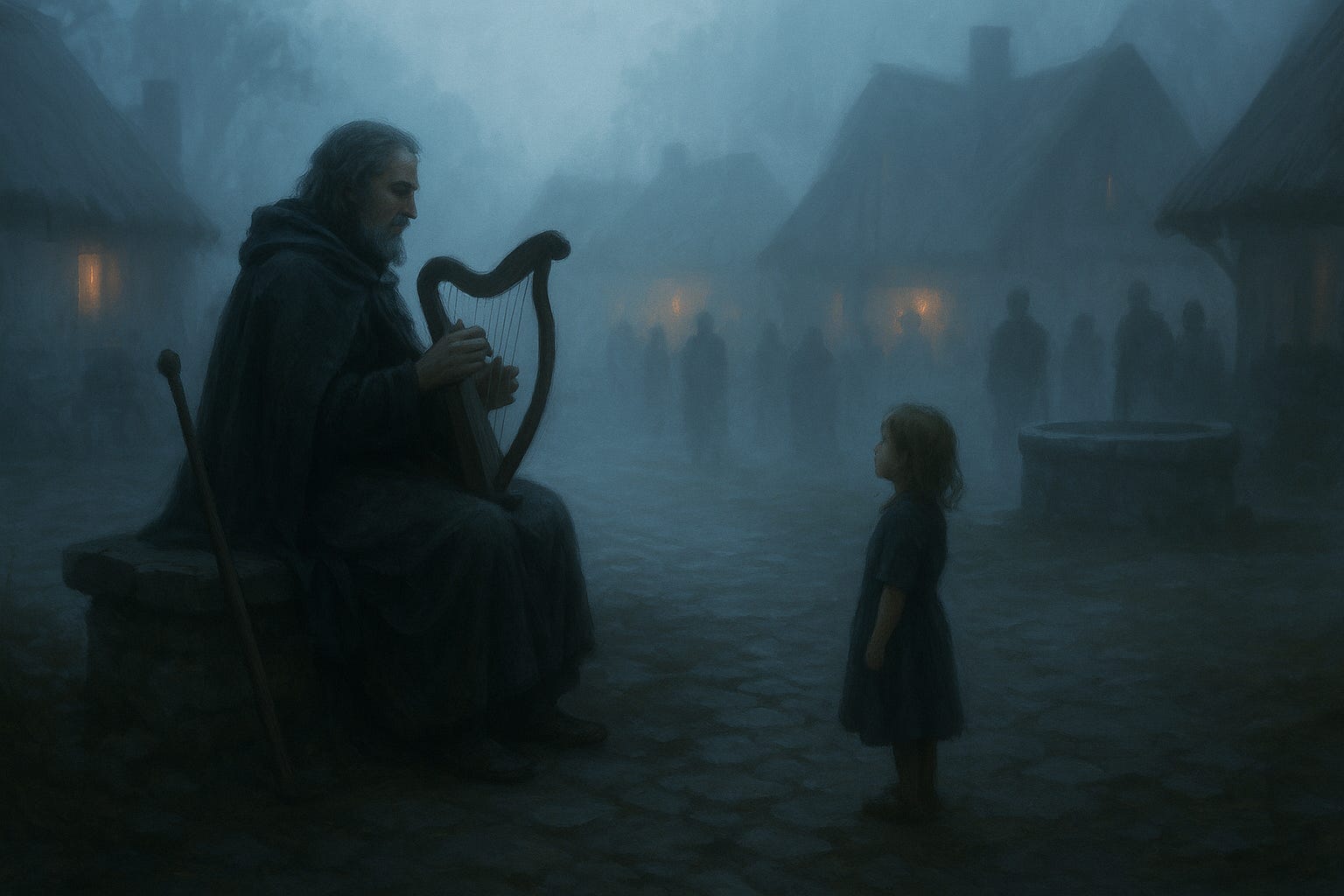
I once sat in the village square of Helithorn, where the mist comes early and lingers long after the sun has climbed. A bard was singing—half-memory, half-song—and the crowd leaned close to hear the old tales of the Fianna.
The bard reached the name like one might touch a relic—carefully, but with pride.
“Calla Greystone,” he said, “whose fire did not falter, even when the Wraithwood howled.”
A hush fell.
And then—
“I’m named for her!”
A girl’s voice—high, certain, and fierce with hope—rang out from near the well.
“I am!”
A ripple moved through the gathered crowd. Laughter, yes—but not mocking. Not quite. It was the sound people make when they want something to be true.
The bard gave a theatrical bow in her direction. “Then the blood of flame runs strong in Helithorn.”
More chuckles. A few nods. The girl's mother gently hushed her, but the name had been spoken now, twice, with pride.
I watched her—the girl, not the bard.
Eyes wide. Chin lifted. As if she could already feel the ember stirring in her chest.
I said nothing.
But in that moment, the story was alive again.
And that is how legends walk.
He told them she was born here, just beyond the reeds of Lough Gur, where the swans do not swim and the fireflies burn too long. He claimed he’d once seen her conjure flame from wet stone. That she was touched by the Wraithwood itself.
A fine telling.
And false in half its bones.
But I said nothing.
Let them keep the story that fits in the mouth. Let the village believe she sprang from their soil, bright and fated. If that brings pride to old hearts and wonder to young ears—so be it.
The truth, you see, is quieter.
It does not sing well in crowded squares.
It waits.
Ash-stained.
Half-forgotten.
Heavy with what could not be saved.
So I closed my eyes.
The bard’s harp faded into the mist.
And I remembered the morning it began.
A mist hung low over the Wraithwood, veiling the roundhouses of Helithorn in threads of silver. The scent of peat smoke clung to the damp earth, and somewhere beyond the thatched rooftops came the steady clang of a forge, the lowing of cattle, and the distant voice of a bard reciting the old tales of the Fianna.
Life here was harsh, but rich in meaning, myth, and the warmth of kin. Helithorn clung to the edge of Lough Gur, its homes built in a ring of stone and sod upon tiny islands in the lake’s shallows. The villagers said the water never gave up its secrets. Some called it cursed. Others, sacred.
It was a place where old magic whispered through trees and hearth-fires alike.
And on that morning, it whispered a name—
not drawn from memory,
but from dream.
On that morning, it whispered of change.
Part II – The Loom and the Ember.
As told by Lirian Ever-Weaver
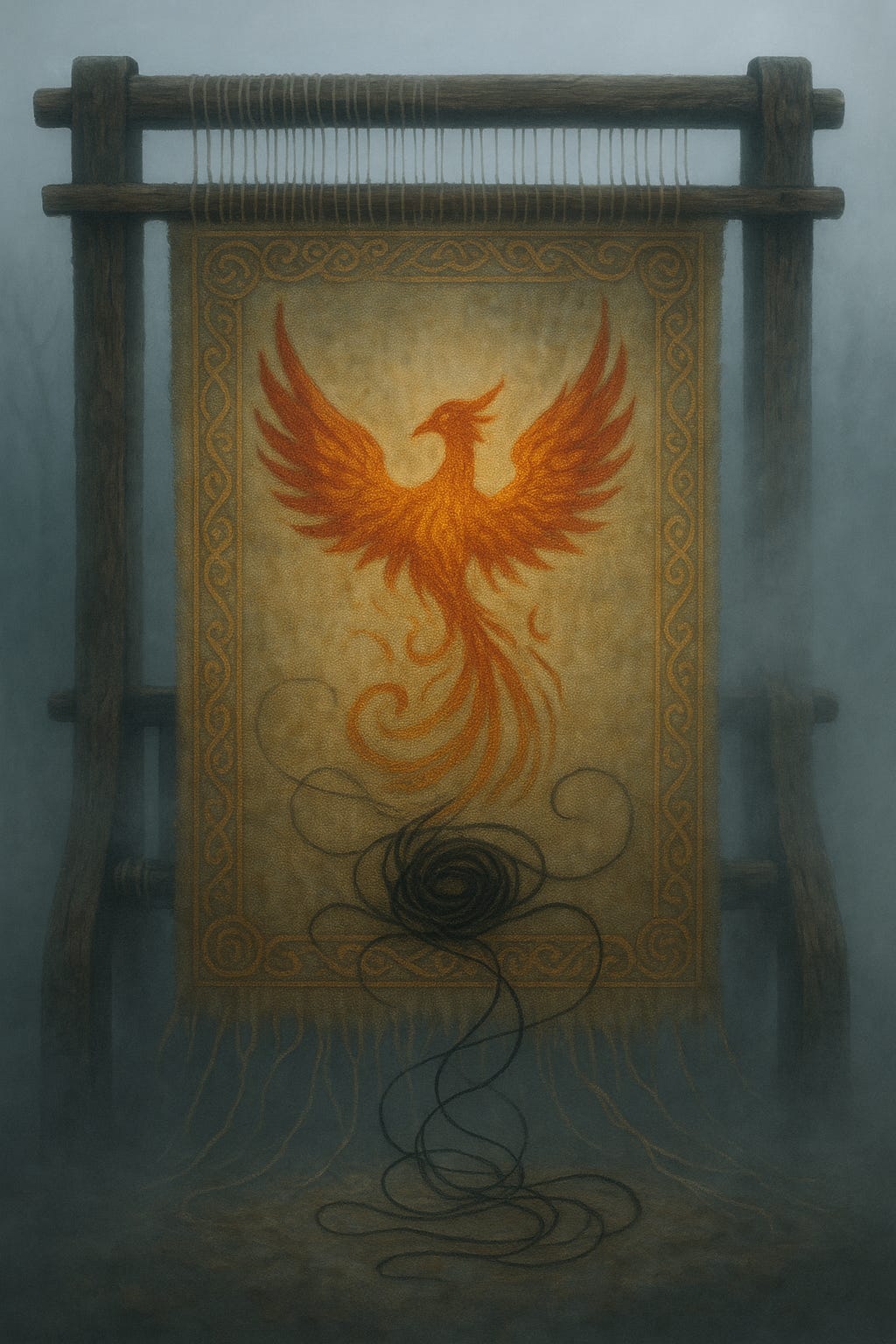
Calla's parents are humble artisans, weaving tapestries of extraordinary beauty, said to capture the very essence of the world’s magic. Her mother, Aerin, wove tapestries that shimmered with threads so fine they seemed spun from moonlight. Her father, Cearnach, carved the loom itself, whispering old words into the wood, as if coaxing the forest to remember.
When their first and only child was born under the waning moon, they sought to give her a name of strength. They meant to name her after a goddess, a warrior, or perhaps both. But the name did not come from memory. It came from dream.
Calla, they called her. Not quite the goddess they had intended—but something older, and perhaps more dangerous.
The moment Calla was born, the mist thickened near the water’s edge—and from it stepped a stag, pale as ash, antlers wreathed in fern. It stood still upon the shallows of Lough Gur, watching the roundhouse as the child’s first cry echoed. Then it vanished into the mist, and the villagers said nothing—but none forgot.
In the years that followed, the mist lingered longer near Calla’s home. Her cradle was always warm, even in frost. Sparks danced at her fingertips when she wept. The hearth never needed kindling.
“She was a quiet child,” the elders said. “But the fire knew her name.”
By the time she could walk, candles flared as she passed. Her breath held the heat of summer, even in winter. Once, a tapestry shimmered with light that was not sunlight—its golden threads glowing faintly as she brushed her fingers across them.
One autumn, Cearnach found a ring of scorched leaves around her as she sat playing in the yard. The flames had touched nothing else.
The village watched. Some in awe. Others with worry.
“Touched by fire,” they whispered. “Or cursed by it.”
Stray embers would rise from her hands when she dreamed. Birds gathered on the eaves of her family’s home. The cattle bowed their heads when she neared the fence.
Stories spread. Wonder turned to unease.
And then—he came.
A traveler. Wrapped in forest green and ash-grey. His eyes kind. His words gentle.
He claimed to be a Chronicler, gathering stories of forgotten villages.
He asked little. He watched much.
He listened to the whispers. He watched Calla play in the mud, her hands steaming with heat she did not yet understand.
He spoke rarely. He watched always. Once, when Calla passed by, the fire in the hearth flickered—waning, as if it knew something she did not.
Even the fireflies paused when he looked their way, as if remembering an older darkness.
“He left no prints,” Aerin would say later. “And the hearth grew cold the moment he passed our door.”
When he turned to go, no one could recall his face—only the way the light bent around him.
Lirian Ever-Weaver notes:
Should this fragment stir your soul, you may seek the fuller song in ink and spine.
The Fianna Chronicles: Awakening
A forgotten legend. A fire rekindled. A warrior’s name remembered.